
 Beet
Beet
 Fruits
 Legumes
 Rapeseed
 Soy
Soy
 Vegetables
 Wheat
Wheat
Molybdenum plays an important role in providing plants with nitrogen, hence the symptoms
its deficiencies may be somewhat similar to nitrogen deficiency symptoms. Plants start
slow growing and have pale green leaves. Lack of molybdenum leads to formation
yellow spots or spots on the leaf plate and marginal chlorosis or old burns
leaves In fruit crops, the lack of molybdenum prevents the formation of pollen and
leads to a decrease in the number of fruits. An especially important role is played by molybdenum
nutrition of leguminous crops, in particular soybeans, as it accelerates development and stimulates
the activity of nodule bacteria, which determines the improvement of nitrogen nutrition, increases
efficiency of phosphorus and potash fertilizers. At the same time, along with the increase in productivity
the protein content increases.
Molybdenum is part of nitrate and nitrite reductase enzymes. Participates in processes
assimilation of nitrogen, protein and phosphorus metabolism. Especially sensitive to food conditions
molybdenum group of legumes. It plays an important role in the formation of fruit quality
grain and stone garden crops. The availability of molybdenum for plants is considerable
depends on the physical and chemical parameters of the soil. Due to the acidic reaction of the soil, its mobility, and
therefore, assimilation by plants is greatly reduced. On soils of organic origin,
molybdenum is strongly bound by organic matter in the inaccessible to plants.
The lack of molybdenum in plants leads to the accumulation of simple nitrogen-containing compounds,
in particular, such dangerous for humans and animals as nitrates and nitrites. With a lack of molybdenum
in plants, the synthesis of ascorbic acid slows down, as a result of which it weakens
regeneration of chlorophyll and the intensity of the photosynthesis process decreases.
Microfertilizer is especially effective on acidic soils and
soils of organic origin. Provides increased plant productivity,
improvement of crop quality.
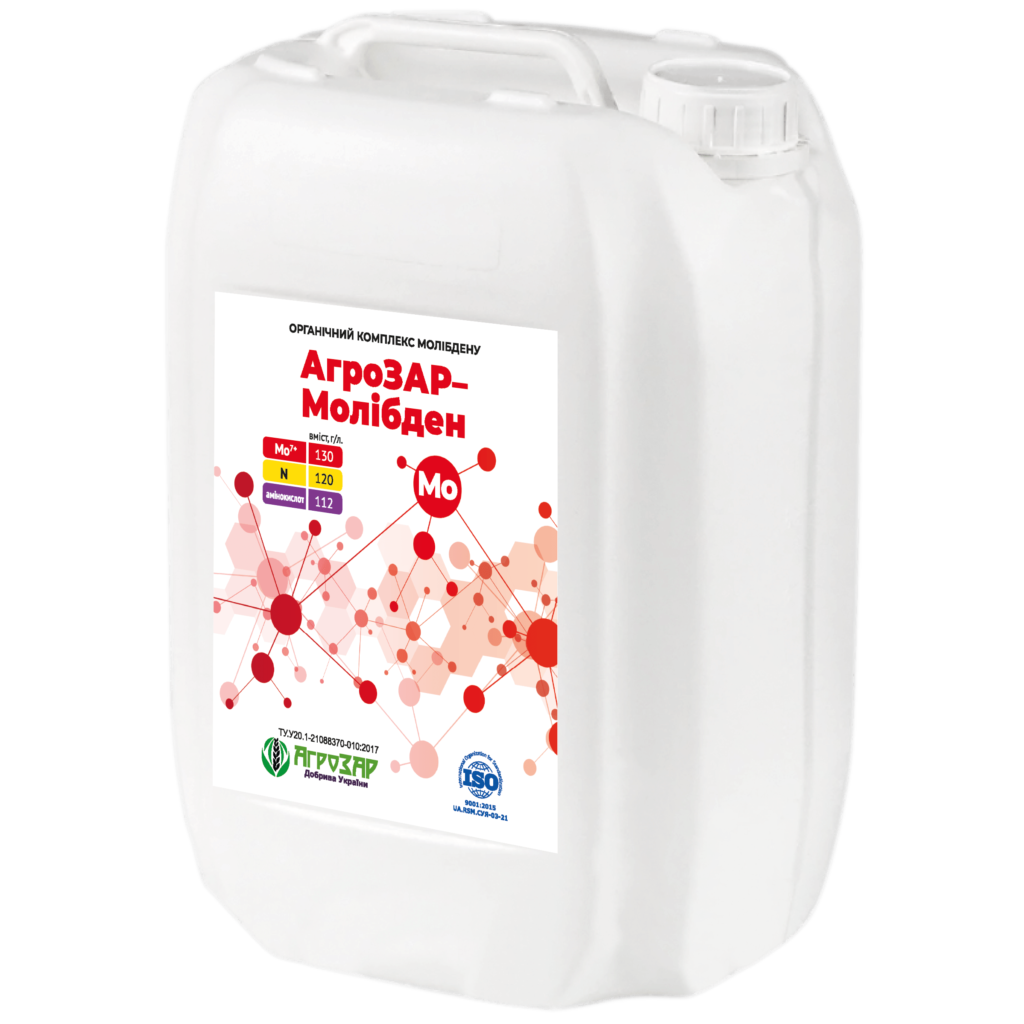
| (Мо) | (N) | Amino acids |
| 130 | 120 | 112 |
grams per liter*
Before application, dilute with water at the rate of (100-300) liters per 1 liter of fertilizer.
COMPATIBILITY WITH OTHER DRUGS SHOULD BE CHECKED BEFORE USE. The fertilizer may be incompatible with drugs that form an acidic environment in solutions.
STORE indoors, out of reach of children, in the manufacturer’s container at a temperature of 0 to + 35 C.
WARNING: do not apply for fertilization two weeks before harvest.
WARRANTY SHELF LIFE: 3 years from the date of manufacture during storage in the original packaging of the manufacturer.
| Culture | Application periods | Consumption rate per application, l / ha |
| Soybeans, legumes | In the presence of (3-5) trifoliate leaves. | 0,15-0,25
|
| At the beginning of budding. | ||
| Winter and spring cereals | From the end of tillering to the tube | 0,2-0,25 |
| Winter rape | In the presence of (4-6) leaves in autumn. |
0,25 – 0,3
|
| From the presence of (5-7) leaves to the beginning of budding. | ||
Сabbage
|
The first – in (10-15) days after emergence.
The next two with an interval of (10-15) days. |
0,1 – 0,2 |
| Beets | In the phase of closing the leaves in a row | 0,3 – 0,4 |
| Fruit trees | From the end of flowering to fruit ripening with an interval (14 – 18) days | 0,2 – 0,3 |

