
 Corn
Corn
 Garden and vegetables
 Legumes
 Soy
Soy
 Sunflower
 Vegetables
 Wheat
Wheat
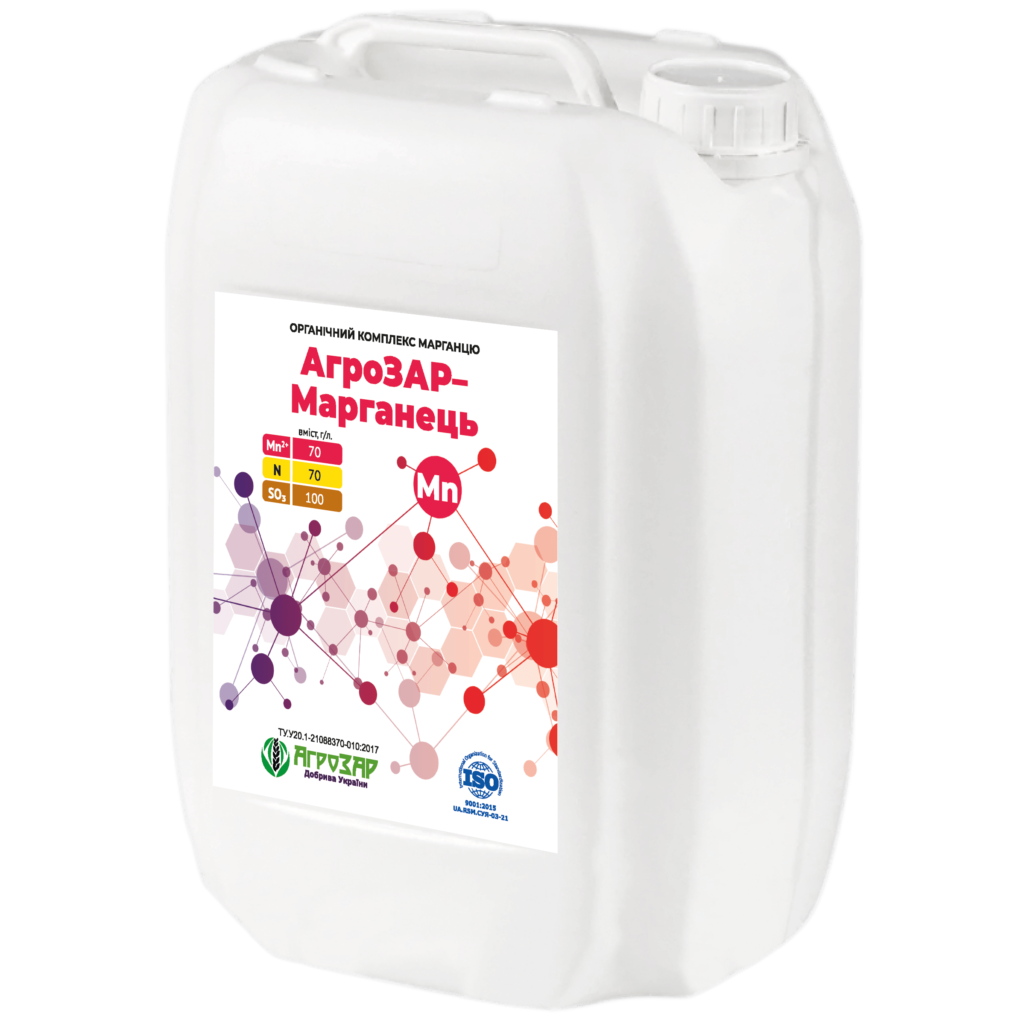
Manganese in plants functions primarily as part of enzyme systems. He
activates several important metabolic reactions and plays a direct role in photosynthesis,
contributing to the synthesis of chlorophyll. Manganese accelerates the germination and development of plants,
simultaneously increasing the plant’s availability and consumption of phosphorus (P) and calcium (Ca).
Manganese participates in the oxidation of ammonia, the reduction of nitrates. Therefore, the higher the level of nitrogen nutrition, the more important the role of manganese for the development of plants.
Various agricultural crops with a harvest carry from 100 to 600 g/ha of manganese.
Its main amount is localized in leaves, in particular in chloroplasts. In plants
Manganese, like iron, is sedentary, so the signs of its deficiency are primarily manifested on
young leaves and similar to chlorosis – the leaves are covered with yellow-green spots with
brown and white areas, their growth is inhibited. Unlike iron chlorosis in
monocots, gray-green or brown spots appear in the lower part of the leaf plate, which
often have a dark border. Signs of manganese starvation in dicots are the same as and
during a lack of iron, only green veins usually do not stand out so sharply on yellowed ones
fabrics In addition, brown necrotic spots appear very quickly. The leaves are dying
even faster than with iron deficiency. At the same time, the concentration of the main elements increases in plant tissues, and the optimal ratio between them is disturbed. In case
manganese deficiency reduces the frost resistance of plants. In addition, there is a weakening
growth and loss of turgor cells, the fragility of damaged leaves also increases.
Manganese deficiency is aggravated at low temperature and high humidity, therefore
winter cereals are most sensitive to its lack in autumn and spring.
| (Mn) | (N) | (SO3) |
| 70 | 70 | 100 |
g per liter*
Before application, dilute with water at the rate of (100-300) liters per 1 liter of fertilizer.
COMPATIBILITY WITH OTHER DRUGS should be checked before use. The fertilizer may be incompatible with drugs that form an acidic environment in solutions.
STORE indoors, out of reach of children, in the manufacturer’s container at a temperature of 0 to + 35 C.
WARNING: do not apply for fertilization two weeks before harvest.
| Culture | Application periods | Consumption rate per application, l / ha |
| Winter and spring cereals | After tillering; | 0,5 – 0,8 |
| From the beginning to the end of milk ripeness. | ||
| Corn | The first – in the presence of (3-7) leaves | 0,5 – 0,8 |
| The next – 2 weeks after the previous one. | ||
| Sunflower | In the presence of (5-7) leaves. | 0,5 – 0,8 |
| In (7-10) days after the first top dressing. | ||
| Soybeans, legumes | In the presence of (3-5) tee sheet. |
0,5 – 0,8 |
| At the beginning of budding. | ||
| At the beginning of the formation and pouring of grains. | ||
| Vegetable crops | The beginning of the appearance of leaves; |
0,5 – 0,8 |
| The beginning of fruit growth. | ||
| Beginning of flowering; | ||
| Fruit trees | From the end of flowering to fruit ripening with an interval (14 – 21) days | 0,5 – 0,8 |

